Issue 121
Autumn, 2026
Editorial
Dear Reader,
Welcome to the Michaelmas issue of New View. In the west of England is a north-south range of hills stretching for some eight miles. You can walk the ridge of these variously named hills and look west into Wales. Made of hardy rocks, including granite, these hills are famous not only for some of the oldest rocks in England but also for their mineral springs and wells. To the south end of this range is a hill called Midsummer Hill and many years ago I had an experience there.
Rudolf Steiner has indicated the significance of the position of the moon in relation to the earth and the sun against the background of the stars at the time of one’s birth. The moon makes a rhythmical journey against this starry background, returning to the same position around every 18.6 years.
The moment of birth is the moment we take up the journey of our earthly destiny and the occurrence throughout our life of this recurring lunar rhythm can at such moments reveal something of our destiny in a special way, when seemingly outer events appear to shape something of our lives. The actual epicentre moment of this rhythm can be calculated astronomically, but the effect of its recurrence can be likened to the ripples spreading out from a stone thrown into a pond. Thus some months before and after the epicentre moment one’s destiny can shine though a little more clearly. This is the picture that Steiner gives.
Aware of this, at the exact occurrence of my second lunar rhythm, which fell on the eve of Midsummer’s day, I climbed the hill of that name for the first time on a warm summer’s evening to take a quiet, contemplative moment. Atop the hill I saw, looking to the north west, an obelisk pointing skywards. I had not seen that in the landscape before, this was a new perspective for me. As the time of my birth approached my gaze began to follow the sun, higher in the sky. Then, for a moment, my own birth moment, it stood, for a gentle instance high over the top of the obelisk. I remember being very open, curious and a little astonished that this was happening. The sun passed on its bright arc and I returned home.
I have thought of this moment many times over the years. Whilst it was a personal time for me I have always clearly felt that this shining sun over the upright, vertical stone obelisk was also a universal picture, deeply connected to the human ‘I’. It spoke gently of what we all experience in our earthly lives, the challenge for the development of a true and healthy human individuality.
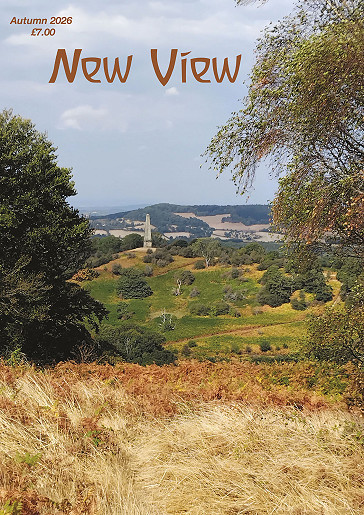
A short while ago I reclimbed Midsummer Hill for the first time since that experience years ago and took the picture that is now on the front cover of this issue of New View. I thought I would share it with the readers for this Michaelmas issue. You can just see the obelisk and might imagine the sun I saw above it, somewhere between the words New View. I believe that is a picture for all of us.
Rudolf Steiner opens our journey though this issue of New View with the Metamorphoses of the Soul: The Mission of Anger, it contains many timeless and timely insights into our incarnated beings.
Charles Duquette, writing from America, offers a thoughtful contemplation of aspects of a novel by Dostoevsky with Ivan’s Ticket: Ivan Karamazov as a Contemporary Puzzle and a Michaelmas perspective.
From Denmark, Michael Brinch calls upon us to think more deeply, with Breaking the Spell.
The Genius and Tragedy of Isaac Newton’s Pursuit of Knowledge finds Christopher Ramsbotham bringing a picture of much that underpins our lives and struggles today.
From Switzerland comes an article that many readers will surely find insightful and helpful: The Riddle of Allergy by Dr. Daphné von Boch.
From Spain, Michael Warden with Jan Martel in Taiwan complete their two-part article on Global Pandemics Seen Anew – Part Two: A Pending Revolution in Science.
Climate: The Whole Picture is a further attempt by Peter Taylor to enable readers to better understand what is really at work in the atmosphere around us all.
From Theatre, via psychodrama to Karma Drama brings an Interview by Richard House with Mike Chase looking at ways to understand our past, from earlier lives, to help the present become better understood into the future.
Terry Boardman has written a deeply researched piece that will repay careful reading. The Club of Rome and Anthroposophy: Between the Spectre and the Nightmare does affect us all.
Matthew Barton has been to the cinema and offers his thoughts in Overkill, a review of the film The Odyssey, where language is an issue.
My sincere thanks to those readers who have already been able to respond to our call help keep New View afloat. I have repeated the appeal on page 88 and hope that others can join in this. I encourage New View readers to consider someone they could offer a gift subscription to. Some readers are already doing this and I believe that is the way how we can gradually step away from the need for this constant fundraising as more gift receivers may then convert to taking out their own subscriptions and support the magazine. Time will tell… please bear us in mind. Of course the content has to remain relevant and I am always open and listening to readers’ comments and feedback.
I hope you find value in this Michaelmas issue.
Wishing you well, wherever you may be,
Tom Raines – Editor.
Contents
| Article/Author | Topics |
|---|---|
Metamorphoses of the Soul: The Mission of Angerby Rudolf Steiner |
|
Ivan’s Ticket: Ivan Karamazov as a Contemporary Puzzleby Charles Duquette |
|
Breaking the Spellby Michael Brinch |
|
The Genius and Tragedy of Isaac Newton’s Pursuit for Knowledgeby Christopher Ramsbotham |
|
The Riddle of Allergyby Dr. Daphné von Boch |
|
Global Pandemics Seen Anew – Part Two: A Pending Revolution in Scienceby Michael Warden and Jan Martel |
|
Climate: The Whole Pictureby Peter Taylor |
|
From Theatre, via psychodrama to Karma Dramaby Richard House interviews Mike Chase |
|
The Club of Rome and Anthroposophy: Between the Spectre and the Nightmareby Terry Boardman |
|
Film Review: Overkill, a review of the film The Odysseyby Matthew Barton |